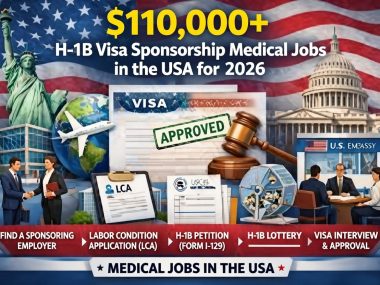
Are you ready to pursue a $110,000 to $400,000 per year medical job in the United States with full H-1B visa sponsorship in 2026?
Hospitals across the country are actively recruiting international medical professionals. Immigration pathways are open, and many employers are prepared to handle visa expenses, legal processing, and even relocation incentives.
For many doctors around the world, this moment represents a rare chance to step into a new professional life abroad. If you have been waiting for the right opportunity, this could be the starting point for building a successful medical career in the United States.
Why Choose Medical Jobs with Visa Sponsorship
Medical careers in the United States offer more than just employment. They provide financial stability, long-term career growth, and in many cases, a clear pathway toward immigration.
In 2026, thousands of healthcare institutions are advertising physician positions with starting salaries above $110,000 and, in many specialties, exceeding $350,000 annually. This demand is particularly strong in states facing physician shortages.
When an employer sponsors your visa, they are making a significant investment. Organizations typically pay for H‑1B Visa filing costs, legal processing fees, credential evaluations, and sometimes relocation packages that can range from $10,000 to $25,000.
These benefits often include:
- Competitive annual income ranging from $110,000 to $450,000 depending on specialty
- Retirement programs such as employer-matched 401(k) plans
- Comprehensive health insurance valued between $8,000 and $20,000 annually
- Paid malpractice insurance that can save physicians over $15,000 each year
- Opportunities for employer-sponsored green card applications after several years of employment
Many foreign-trained doctors worry that the U.S. immigration process may be too complex. However, the reality in 2026 is very different. Healthcare providers understand the physician shortage and are increasingly open to hiring international talent.
Hospitals across states such as Texas, Florida, Illinois, California, and New York continue to recruit globally. For doctors planning long-term careers, visa-sponsored roles offer financial security, immigration options, and access to one of the world’s most advanced healthcare systems.
Types of Medical Jobs in the USA
The U.S. healthcare system is one of the largest in the world. In 2026, it employs more than 20 million professionals, with a substantial number of physicians and specialists coming from international backgrounds and earning six-figure salaries.
Below are some of the most common categories where visa sponsorship is frequently available.
Primary Care Physicians
Primary care doctors form the foundation of the U.S. healthcare system. Physicians specializing in family medicine or internal medicine are particularly sought after, especially in underserved regions.
Typical salary ranges include:
- Family Medicine Physician – $190,000 to $250,000 annually
- Internal Medicine Physician – $200,000 to $270,000 annually
- Pediatrician – $180,000 to $240,000 annually
These positions often offer visa sponsorship because many rural and mid-sized communities urgently require primary care providers.
Specialized Medical Doctors
Specialists usually earn significantly higher salaries and often have stronger negotiating power when discussing employment packages.
Common specialties and salary ranges include:
- Cardiologist – $350,000 to $500,000 annually
- Anesthesiologist – $300,000 to $450,000 annually
- Psychiatrist – $250,000 to $330,000 annually
- Radiologist – $320,000 to $480,000 annually
Specialists are especially in demand within major hospital networks and urban healthcare systems.
Allied Medical Professionals
While this guide focuses mainly on physicians, several advanced healthcare roles also receive visa sponsorship opportunities.
Examples include:
- Nurse Practitioner – $110,000 to $160,000 annually
- Physician Assistant – $105,000 to $150,000 annually
- Physical Therapist – $85,000 to $120,000 annually
Choosing the right path depends on both your professional qualifications and long-term immigration plans.
High-Paying Medical Jobs with Visa Sponsorship in the USA
For professionals focused on maximizing income, certain specialties offer particularly impressive compensation.
In 2026, some physicians sign employment contracts exceeding $400,000 annually, often combined with productivity bonuses and partnership opportunities.
Hospitals competing for skilled physicians frequently provide signing bonuses between $20,000 and $75,000 simply to secure qualified candidates.
Among the highest-paying visa-sponsored roles are:
- Orthopedic Surgeon – $450,000 to $650,000 per year
- Cardiologist – $400,000 to $550,000 per year
- Gastroenterologist – $380,000 to $520,000 per year
- Dermatologist – $350,000 to $500,000 per year
- Anesthesiologist – $320,000 to $450,000 per year
General surgeons working within hospital systems can also earn between $300,000 and $420,000 annually.
Many of these positions exist in regions participating in programs such as the Conrad 30 Waiver Program, which allows international doctors to work in underserved communities while advancing their immigration status.
Private medical groups sometimes offer partnership tracks as well. After several years of employment, physicians may become partners in the practice, which can increase annual earnings to $600,000 or more.
Salary Expectations for Medical Doctors
In 2026, physician compensation in the United States generally falls between $220,000 and $340,000 annually on average. However, specialization, location, and experience can significantly influence income.
Doctors completing residency programs often begin with salaries ranging from $180,000 to $220,000. Within a few years, many exceed $250,000 annually, while specialists frequently earn more than $400,000.
Location plays a major role. States such as California, Texas, and Florida often offer higher compensation due to strong demand for healthcare professionals.
Some rural hospitals provide slightly lower base salaries but compensate with bonuses worth $30,000 to $80,000.
Typical physician compensation packages may include:
- Base salary ranging from $180,000 to $500,000
- Signing bonuses between $20,000 and $75,000
- Relocation assistance of $10,000 to $25,000
- Performance bonuses of $15,000 to $120,000 annually
- Employer retirement contributions of up to 5 percent
Over a ten-year career, a specialist earning $400,000 annually could generate more than $4 million before bonuses or investments.
Below is a quick overview of common physician salaries in 2026.
- Family Medicine Physician – $190,000 to $250,000
- Internal Medicine Physician – $200,000 to $270,000
- Pediatrician – $180,000 to $240,000
- Psychiatrist – $250,000 to $330,000
- Cardiologist – $400,000 to $550,000
- Orthopedic Surgeon – $450,000 to $650,000
- Radiologist – $320,000 to $480,000
- Anesthesiologist – $320,000 to $450,000
These figures reflect real market averages based on recent physician recruitment data.
Eligibility Criteria for Medical Doctors
For international physicians interested in earning between $180,000 and $500,000 annually in the United States, eligibility requirements form the first step.
The U.S. healthcare system continues to face shortages in multiple regions, including Texas, Florida, Illinois, Ohio, and parts of New York.
To qualify, candidates must hold a recognized medical degree equivalent to a U.S. MD or DO. International graduates typically verify their credentials through the Educational Commission for Foreign Medical Graduates.
Applicants must also complete the required United States Medical Licensing Examination exams to demonstrate their medical knowledge and readiness to practice in the United States.
Many international physicians must complete residency training within the U.S., though some states provide alternative licensing pathways for experienced specialists.
Typical eligibility requirements include:
- Passing USMLE Step 1 and Step 2 CK
- Obtaining ECFMG certification
- Securing placement in a residency program
- Demonstrating English language proficiency
Fortunately, many hospitals actively support international doctors throughout this process.
Requirements for Medical Doctors
Hospitals offering salaries above $250,000 are looking for professionals who demonstrate expertise, reliability, and long-term commitment.
In most cases, physicians must complete a U.S.-accredited residency program. Residency training usually pays between $60,000 and $75,000 annually before transitioning to full physician salaries.
Doctors must also obtain an unrestricted medical license from the state in which they plan to practice. Licensing boards in states such as Texas, Florida, and California each have unique application procedures and fees.
Board certification within a medical specialty is also highly recommended. Board-certified physicians typically earn 10 to 20 percent more than non-certified peers.
Additional expectations include:
- Clean malpractice history
- Strong professional references
- Willingness to serve in underserved areas if necessary
- Successful background and credential verification
Employers investing thousands of dollars in visa sponsorship look for candidates who demonstrate professionalism and reliability.
Visa Options for Medical Doctors
The most widely used immigration pathway for physicians is the H‑1B Visa.
This visa allows medical professionals to work legally in the United States for up to six years and can lead to permanent residency through employment-based immigration.
Other visa pathways include:
- J-1 visa for residency training
- O-1 visa for doctors with extraordinary achievements
- Employment-based green card categories such as EB-2 or EB-3
- Cap-exempt H-1B sponsorship through nonprofit hospitals or academic institutions
Physicians serving underserved communities may qualify for programs that accelerate their path to permanent residency.
Documents Checklist for Medical Doctors
A successful application depends heavily on accurate documentation. Even a small missing document can delay an offer worth hundreds of thousands of dollars annually.
Essential documents typically include:
- Medical degree certificate and transcripts
- ECFMG certification
- USMLE exam results
- Updated professional CV
- State medical license or application confirmation
- Board certification records
- Valid passport
- Professional references
- Official employment offer letter
Immigration attorneys may also require additional financial and employment records during the visa petition process.
Proper preparation ensures employers can move quickly once they decide to hire you.
How to Apply for Medical Jobs in the USA
Begin by completing the USMLE examinations and securing ECFMG certification. Without these steps, most physician applications cannot proceed.
Next, prepare a professional U.S. style medical CV highlighting clinical experience, research activities, and patient care achievements.
Focus your job search on states with strong demand for international physicians, including Texas, Florida, Illinois, Ohio, California, and New York.
Many hospitals work directly with recruitment agencies that specialize in placing international doctors.
During contract negotiations, physicians should carefully review compensation packages, including base salary, signing bonuses, relocation support, productivity incentives, retirement contributions, and malpractice coverage.
Applying consistently and submitting multiple applications significantly increases the chances of receiving job offers.
Top Employers & Companies Hiring Medical Doctors in the USA
Several major healthcare systems across the United States regularly sponsor international physicians due to ongoing staffing shortages.
These employers include:
- University-affiliated academic medical centers
- Large nonprofit hospital networks
- Rural healthcare systems participating in federal waiver programs
- Private specialty medical groups
Academic institutions often offer salaries between $190,000 and $260,000 but provide strong research support and immigration sponsorship opportunities.
Private hospitals and medical groups may offer compensation between $300,000 and $500,000 plus bonuses.
Hospitals located in Texas, Florida, California, Illinois, and New York frequently provide relocation assistance between $10,000 and $30,000 along with signing bonuses that can reach $75,000.
Employers with established immigration teams usually handle visa processing efficiently.
Where to Find Medical Jobs in the USA
High-paying medical positions are typically listed on hospital career websites, physician recruitment platforms, and medical association job boards.
Common sources include:
- Hospital employment portals
- Healthcare recruitment agencies
- Professional medical association job boards
- University hospital career pages
- Rural healthcare recruitment networks
States such as Texas, Florida, California, New York, Illinois, and Pennsylvania consistently advertise visa-sponsored roles.
Rural and semi-urban hospitals often offer stronger sponsorship opportunities and faster immigration processing.
Setting up job alerts and submitting applications regularly can significantly increase success rates.
Working in the USA as Medical Doctors
Practicing medicine in the United States offers access to structured healthcare systems, modern technology, and strong legal protections for medical professionals.
Most physicians work between 40 and 60 hours per week depending on their specialty and call schedules.
Typical employment packages include:
- Base salary between $200,000 and $500,000
- Health insurance coverage for physicians and their families
- Paid vacation ranging from three to six weeks annually
- Continuing medical education funding of $3,000 to $6,000 per year
- Employer retirement contributions
Cost of living varies by region. States such as California and New York have higher housing costs, while Texas and Florida often provide lower taxes and more affordable living.
Many international physicians report financial stability within a few years of practicing in the United States.
Why Employers in the USA Want to Sponsor Medical Doctors
The United States continues to face a major physician shortage. An aging population and rising healthcare demand have created staffing gaps in many regions.
Hospitals in underserved communities often struggle to recruit enough doctors locally. As a result, they offer visa sponsorship, competitive salaries, and even permanent residency sponsorship.
From a hospital’s perspective:
- Unfilled physician positions can result in millions of dollars in lost revenue
- Patient care capacity decreases without adequate staffing
- Government healthcare programs require physician coverage
For employers, sponsoring a qualified physician is a strategic investment.
FAQ about Medical Jobs in the USA
Can foreign medical doctors apply for H-1B visa jobs in the USA in 2026?
Yes. International doctors who complete USMLE exams, obtain ECFMG certification, and secure residency training can apply for H-1B sponsored physician positions.
What is the average salary for medical doctors in the USA?
In 2026, most physicians earn between $220,000 and $340,000 annually, while certain specialties exceed $400,000 per year.
Do U.S. hospitals pay for H-1B visa sponsorship?
Many hospitals cover visa filing fees and legal expenses, which often total between $6,000 and $12,000.
Is residency required for foreign doctors?
In most cases, yes. Completing a U.S.-accredited residency program is necessary for full licensure.
Which states sponsor the most physicians?
States with strong recruitment demand include Texas, Florida, California, New York, Illinois, and Pennsylvania.
Can physicians obtain permanent residency in the United States?
Yes. Many doctors transition from H-1B visas to employment-based green cards through EB-2 or EB-3 immigration categories.
How long does the H-1B visa process take?
Processing times vary, but with premium processing, petitions reviewed by United States Citizenship and Immigration Services can be approved within a few weeks if documentation is complete.

 Xmediate